


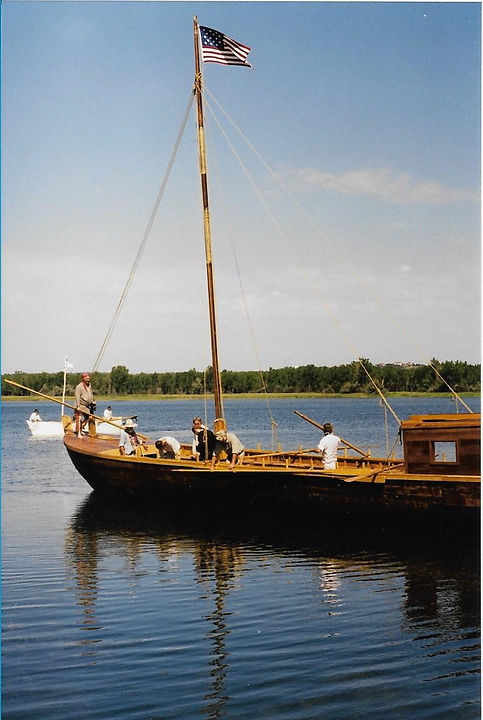
The 1805 Keelboat Return Party: Safeguarding the Expedition’s Legacy
When Lewis and Clark reached Fort Mandan in late 1804, they made a critical decision: to send the keelboat Discovery back down the Missouri River in the spring. The vessel was too large for the narrow, rapid-filled upper Missouri—but more importantly, it carried precious cargo.
Why Send the Keelboat Back?
The captains knew that if disaster struck the Corps of Discovery as they pressed westward, the world might never hear their story. Returning the journals, maps, specimens (including a live prairie dog), and scientific dispatches
by keelboat guaranteed their survival—even if the explorers did not.
Leading the Return: Corporal Richard Warfington
“There was not one of the party destined to be returned... in whom I could place the least confidence except himself.” — Captain Meriwether Lewis
Hand-picked to command the return crew, Corporal Richard Warfington was a seasoned soldier. Born in North Carolina in 1777, he was part of the 2nd Infantry Regiment when he joined the Corps in 1804. At over 5'10", Warfington was known for his composure, loyalty, and leadership.
Though no journal from the return trip survives, Lewis later praised Warfington’s dedication in a letter to Secretary of War Henry Dearborn. Congress denied Lewis’s request to reward him further—but Warfington did receive the same 320-acre land grant as the rest of the Corps.
Meet the Return Party
Warfington led a diverse group on the return journey to St. Louis in spring 1805. Alongside him were Privates Boley, Dame, Tuttle, and White, as well as former members of the Corps—Newman and Reed—who had previously been discharged. Also aboard were French interpreter and pilot Jean Baptiste Gravelines, two French boatmen, and possibly two more French-Canadian traders. A lame Arikara chief, hoping to return to his village, also traveled with them.
A pirogue traveling with the main keelboat carried two trappers who had first been encountered near the Cannonball River. When the party reached the Arikara villages, fur trader Antoine Tabeau and four of his employees joined the group with a shipment of pelts. Chief Ankedoucharo, preparing for a diplomatic visit to meet President Jefferson, also boarded here, with Gravelines continuing as interpreter.
During the voyage downriver, the group was joined by a delegation of 44 chiefs from various tribes—including the Ponca, Sioux, Omaha, Oto, and Missouri. The entire party reached St. Louis on May 20, 1805.
Trouble on the Trail
Private Moses Reed: Desertion and Disgrace
In August 1804, Reed asked to retrieve a lost knife—and never returned. His stolen supplies led Clark to suspect desertion. Lewis sent George Drouillard and three men to track him down, with orders to return Reed "peaceably—or kill him."
After two weeks, Reed was captured, tried, and sentenced to run the gauntlet four times—each man of the Corps whipping him with nine switches. Even the visiting Oto chiefs were appalled. Expelled from the Corps, Reed still descended the Missouri with the return party in spring 1805 and then vanished from record.
🔍 Fun Fact: Even months earlier, Clark noted friction: “Reed saws better from practice,” he wrote, hinting at Reed’s early struggles while sawing lumber with another private.
Private John B. Newman: Redemption Denied
Charged with insubordination in October 1804, Newman was court-martialed and flogged—an act that horrified a visiting Arikara chief. Yet Lewis later praised Newman’s “zeal” and “uncommon activity” in protecting the keelboat during its return voyage.
Despite proving himself, Newman wasn’t allowed to rejoin the Corps. He later reemerged in 1832 when he married Olympia Dubreuil in St. Louis and entered the fur trade. In 1838, he was killed by the Yankton Sioux.
The Return Journey: A Quiet Triumph
Though largely forgotten, the Keelboat Return Party played a crucial role in preserving the legacy of the Lewis and Clark Expedition. Thanks to these men, the documents and discoveries of the Corps of Discovery reached civilization—and history was not lost.

Journal Duty

Lewis and Clark Bio's

About Sacagawea

About York

Seaman - The Discovery Dog

Lewis and Clark Among the Tribes

Discover the Rivers of Lewis and Clark

Jefferson Peace Medals

Corps Roster

1805 Keelboat Return Party

Medical Aspects

Chow du jour
Lewis and Clark Trail
Icons, Treasures, Legends & Lore

National Geographic - Lewis & Clark: The Great Journey West!

Explore some of the most beautiful and rugged
areas in America
LewisandClarkTrail.com