All of this information was to be
recorded in their journals. President Jefferson also instructed
Captain Meriwether Lewis to note when plants were in bloom and to
investigate their potential value in commerce.
What remains of the collection taken by Lewis are now housed
in the Lewis and Clark Herbarium at the Academy of Natural
Sciences in Philadelphia. Members of the Expedition employed
a number of plants, using them for food and medicine, as
well as firewood, shelter, ax handles and dugout canoes. At
the conclusion of the journey, Lewis had mentioned 260
plants in his journals, and over half of them were new to
science.
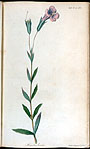
Lewis’ Blue Flax "boo ah- nut sue" (Linum
lewisii)
Lewis-"Perennial flax. Valleys of the Rocky Mountains, July
09, 1806."
On July 18, 1805, Lewis wrote, "the bark of the stem is
thick strong and appears as if it would make excellent
flax." Because linen was an important commodity during that
time, Lewis thought the blue flax might have great
commercial potential in the east. The Native Americans wove
the tough stem fibers into fishing nets, ropes, and other
cordage. Seeds from a cultivated species are now sold in
grocery stores, being valued for their high fiber content
and nutritional qualities.
 Lewis’
Monkeyflower (Mimulus lewisii)
Lewis’
Monkeyflower (Mimulus lewisii)
Lewis- "the head spring of the Missouri, at the foot of
Portage hill" August, 1805.
Marked with hairy yellow patches and red dots to attract
insects, the monkeyflower also attracts hummingbirds and
sphinx moths.
Thin-leaved Owl Clover (Orhocarpus
tenuifolius)
Lewis-"Valley of Clark’s R, July, 1806."
No relation to true clover, the owl clover’s bright colors
are actually special leaves that somewhat conceal the
flowers. This annual root parasite was mentioned by Lewis in
the journal on July 2, 1806, writing that he found "two
species of native clover here, the one with a very narrow
small leaf & a pale red flower."
The Blackfeet used owl clovers to dye horsechair, feathers,
and hides.
Pink Elephants "so-you-wund" (Pedicularis groenlandica)
"On the low plains on the heath of Clark’s R. Jul. 6th
1806."
Some Native American children enjoyed the sweet nectar,
eating the flowers like candy. The Cheyenne made a tea to
relieve coughing.
Lewis Syringa (Philadelphus lewisii)
Lewis-"On the waters of Clarks R. July 4th 1806."
Some Native Americans used the hard wood for making bows,
arrows, and many other utilitarian pieces. Additionally,
they found value in the plant’s healing properties, making
teas, poultices, and salves.
Common Chokecherry "doe-oh numb" (Prunus virginiana)
Lewis- "Prunus A cherry found near the beaver bents on the
Missouri-Augst. 10th 1806."
On June 11, 1805, Lewis was very ill. He boiled chokecherry
twigs "until a strong black decoction of an astringent
bitter taste was produced." Hours after drinking two doses
of this, he felt completely well.
Golden Currant "oh-ah bo-gombe" (Ribes aureum)
Lewis- "Yellow currant of the Missouri, July 29, 1805."
On July 17, 1805, Lewis noted that, "there are a great
abundance of red yellow purple & black currants,…I find
these fruits very pleasant particularly the yellow currant
which I think vastly preferable to those of our gardens."
The Shoshone ground the second bark, using it as a poultice.
Red False Mallow "see-go kund" (Sphaeralcea coccinea)
Lewis- "Plains of the Missouri, July 20, 1806."
The leaves of this plant are slimy. Native Americans rubbed
the chewed plant on their hands and arms to protect the skin
from burns while cooking. The whole plant was employed
to relieve a myriad of ailments, as well as to make a sweet
tea with which to take medicine with.
Indian Basket Grass "woodah so-nip" (Xerophyllum tenax)
Lewis- "The leaves are made use of by the natives, to make
baskets & other ornaments. On high land, Rocky Mountains,
June 15th, 1806."
Some Native Americans used the tough evergreen leaves to
weave watertight baskets & garments. It is not uncommon for
it to bloom only once every seven years.
Mountain Death Camas "dah-sego (Zigadenus elegans)
Lewis- "On the Cokalaiskit R., July 7, 1806."
This foul-smelling plant was placed around the perimeter of
some Native American encampments in the belief that it would
repel evil spirits.
The entire plant, including the nectar, is poisonous even to
introduced honeybees, but not to our native bees.
Serviceberry duh-umb (Amelanchier alnifolia)
Lewis-"Serviceberry. A small bush, the narrows of the
Columbia R. April 15, 1806."
On August 16, 1805, Whitehouse wrote, "Our interpreters Wife
went on Shore & found great numver of fine berries, which is
called service berries."
Balsamroot "ah-kun" (Balsamorrhiza sagittata)
Lewis- "The stem is eaten by the natives, without any
preparation. On the Columbia. April 14th,1806."
Mariposa Lily "doe-sa sego" (Calochortus sp.)
Lewis-"A small bulb of a pleasant flavour, eat by the
natives. On the Kooskooskee. May 17, 1806."
Blue Camas "pah-sego" (Camasia quamash)
Lewis- "Near the foot of the Rocky Mountains on the Quamash
flats. June 23, 1806."
Clark wrote on September 23, 1805, that "the woman were
busily employed in gathering and drying the Pas-she co root
of which they had great quantities dug in piles."
Upon seeing it on June 12, 1806 Lewis wrote, "the quamash is
now in blume and from the colour of its bloom at a short
distance it resembles lakes of fine clear water, so complete
in the deseption that on first sight I could have sworn it
was water."
Rubber Rabbitbrush "sah-nah ko-ah" (Chyrsothamnus nauseosus)
Lewis- "Big Bend of Missouri, September 21, 1804."
Lewis also noted that "The goat or antelope feed on it in
the winter, it is the growth of the high bluffs."
Some Native Americans chewed the latex sap like gum, used
the branches to smoke hides, and the yellow flowers to make
a dye for their wool, leather, and baskets.
Pink Cleome (Cleome serrulata)
Lewis- "August 25, 1804, growth of the open Prairies."
This plant has a somewhat distinctive smell that disappears
after cooking. The nourishing seeds were ground into flour,
and the boiled leaves and flowers were eaten.
Mountain Lady’s Slipper (Cypripedium montanum)
On June 30, 1806, Lewis wrote, "I also met with the plant in
blume which is sometimes called the lady’s slipper or
mockerson flower. It is in shape and appearance like ours
only that the corolla is white, marked with small veigns of
pale red longitudinally on the inner side."
This plant was favored by Native Americans for its medicinal
and love potion qualities.
Purple Prairie Clover "so-nee donzuip" (Dalea purpurea)
Lewis- "found September 2ed the Indians use it as an
application to fresh wounds. They bruise the leaves adding
litter water and apply it."
Some Native Americans also brewed a tea from the leaves and
ate the root uncooked, which is said to be sweet.
Indian Blanket (Gaillardia aristata)
Lewis- "Rocky Mountains dry hill. July 7th , 1806."
To many Native American people, the Indian blanket is a gift
of liveliness and sunshine from our Mother, the Earth. It
also represented the health, earthiness, and wholesomeness
of the common people.
The seeds of this wildflower were either eaten raw or dried
over a fire. Dried seeds were ground into meal or flour for
small cakes. These light-weight, high-energy cakes were
carried on the Indian’s travels. Many medicines were made
from this plant as well. Today, herbalists use this plant as
an anesthetic and diuretic.
Wild Licorice (Glycyrrhiza lepidota)
On May 08,1805, Clark wrote, "In walking on Shore with the
Interpreter & his wife, Geathered on the Sides of the Hills
wild Lickerish & the white apple…"
The Native Americans who lived along the Missouri and
Columbia Rivers knew this plant well. Fifty times sweeter
than sugar, the Indians used the root for food, medicine,
and ceremonial purposes. Lewis and Clark purchased a great
deal of licorice from the Indians during the Expedition.
"Flowering Plants Lewis &
Clark Collected Along the Snake and Columbia River" by William
H. Rickard, Ph.D. Botanist
 PDF 290 kb
'Fish We Have Met With'
Pacific Coast Fishes of the Lewis & Clark Expedition by Dennis Dauble, Ph.D.
Fisheries biologist
PDF 393 kb |